Inventors and researchers have been developing robots for nearly 70 years. All the machines they have built to date-whether for factories or elsewhere-have one thing in common: They are all powered by electric motors, a 200-year-old technology. Even the arms and legs of walking robots are driven by motors, rather than muscles, as humans and animals do. This partly explains why they lack biological mobility and adaptability.
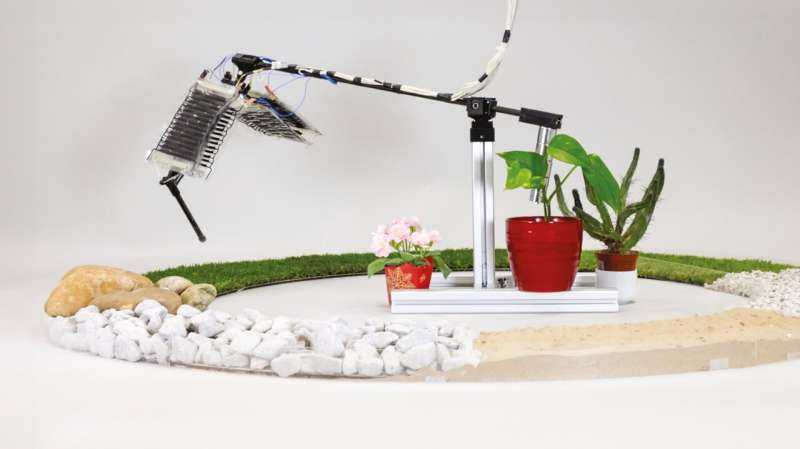
A new muscle-driven robotic leg not only saves more energy than traditional robotic legs, but also allows for high jumps and rapid movements, as well as detecting obstacles and responding to them-all without the need for complex sensors. The new leg was developed by researchers at ETH Zurich and the Max Planck Institute for Intelligent Systems (MPI-IS) under a research partnership at the Max Planck ETH Center for Learning Systems (CLS).
The CLS team was led by Robert Katzschmann of the Federal Institute of Technology Zurich and Christoph Keplinger of MPI-IS. Their doctoral students Thomas Buchner and Toshihiko Fukushima are co-first authors of the team’s paper published in Nature Communications on animal-inspired musculoskeletal robot legs.
Electric as a balloon
Like humans and animals, the extensors and flexors ensure that the robot’s legs can move in both directions. These electro-hydraulic actuators, called HASEL by the researchers, are connected to the bone through tendons.
The actuator is a plastic bag filled with oil, similar to the plastic bags used to make ice cubes. About half of each bag is coated on both sides with black electrodes made of conductive material.
Buhner explained: “Once we apply a voltage to the electrodes, they attract each other due to static electricity. Similarly, when I rub my head with a balloon, my hair sticks to the balloon due to the same static electricity.”
As the voltage increases, the electrodes come closer and push the oil in the bag to one side, making the bag shorter overall.
Pairs of actuators connected to bones produce the same pairs of muscle movements as organisms. When one muscle shortens, another muscle lengthens. The researchers used computer code that communicates with high-voltage amplifiers to control which actuators contract and extend.
More efficient than an electric motor
The researchers compared the energy efficiency of their robotic legs to that of traditional robotic legs driven by electric motors. In addition, they analyzed how much energy was unnecessarily converted into heat.
“On infrared images, it’s easy to see that if the motorized leg had to remain in a curved position, it would consume more energy,” Buhner said.
In contrast, the temperature of the electro-hydraulic legs remains constant. This is because artificial muscles are electrostatic.
“It’s like the example of balloons and hair, and the hair stays on the balloon for a long time,” Buhner added.
“Typically, motor-driven robots require thermal management, which requires an additional radiator or fan to spread heat into the air. Our system doesn’t need them,”Fukushima said.
Move flexibly over uneven terrain
The jumping ability of robot legs is based on their ability to explosively lift their own weight. The researchers also showed that robotic legs are highly adaptable, which is particularly important for soft robots. Only if the musculoskeletal system is elastic enough can it adapt flexibly to the terrain.
“It’s no different for biology. For example, if we can’t bend our knees, walking on uneven surfaces becomes more difficult,”Katzschman said. “Imagine walking off the sidewalk and walking onto the road.”
Compared to motors that require sensors to constantly indicate the angle of the robotic leg, artificial muscles adapt to the appropriate position by interacting with the environment. This is driven by only two input signals: one for bending the joint and the other for extending the joint.
Fukushima explained: “Adapting to the terrain is a key aspect. When a person jumps into the air and lands, they don’t have to consider in advance whether their knees should be bent 90 degrees or 70 degrees.” The same principle applies to the musculoskeletal system of the robot leg. When landing, the leg joints will adaptively move to the right angle based on whether the surface is hard or soft.
Emerging technologies open up new possibilities
The research field of electro-hydraulic actuators is still very young and only appeared about six years ago.
“The robotics field is making rapid progress in advanced control and machine learning; in contrast, there is much less progress in the equally important robotic hardware. This publication is a powerful reminder of the potential for introducing disruptive innovation. New hardware concepts, such as the use of artificial muscles,”Keplinger said.
Katzschmann added that electro-hydraulic actuators are unlikely to be used in heavy machinery on construction sites, but they do have specific advantages over standard electric motors. This is particularly evident in applications such as jigs, where the movement must be highly customized based on whether the object being grasped is a ball, egg, or tomato.
Katzschman does have one reservation: “Our system is still limited compared to walking robots with electric motors. The legs are currently connected to a pole and can jump in circles and cannot move freely yet.”
Future work should overcome these limitations and open the door to the development of truly walking robots with artificial muscles. He further elaborated: “If we combine robot legs with quadruped robots or two-legged humanoid robots, maybe one day, when it is powered by batteries, we can deploy it as a rescue robot.”
There are links in the video below this video. If you are interested, you can open it and have a look.
Thank you for watching this video. If you like it, please subscribe and like it. thank
Original text:https://techxplore.com/news/2024-09-robot-leg-powered-artificial-muscles.html
More information: Electrohydraulic musculoskeletal robotic leg for agile, adaptive, yet energy-efficient locomotion, Nature Communications (2024). DOI: 10.1038/s41467-024-51568-3
More information: Electro-hydraulic musculoskeletal robot legs enable agile, adaptive and energy-saving movements, Nature Newsletter (2024). DOI:10.1038/s41467-024-51568-3
Journal information: Nature Communications
Journal information: Nature Newsletter
Oil tubing: